— Market Insights
Mumbai Real Estate Market 2026: Key Trends, Opportunities & What Homebuyers Should Know
Mumbai's real estate market is entering 2026 with a stronger focus on premium housing, infrastructure-led growth and value-driven buying. Here's what homebuyers and investors should watch before making a property decision.
By Admin · Published 8 August 2026 · 5 min read

Mumbai's real estate market continues to evolve as buyers become more selective, developers focus increasingly on premium housing, and major infrastructure projects reshape the region's residential landscape.
For homebuyers and investors, 2026 is less about simply asking "Will property prices increase?" and more about understanding where demand is moving, which locations have sustainable growth potential, and whether a particular property offers genuine long-term value.
The Mumbai Metropolitan Region (MMR) is particularly interesting because its growth is no longer confined to traditional established locations. Improved connectivity, redevelopment, new infrastructure and expanding employment corridors are creating opportunities across several micro-markets.
1. The Market Is Becoming More Value-Driven
The residential market has witnessed an important shift in recent years. Buyers are increasingly looking beyond the lowest possible ticket price and evaluating the overall value of a property.
Location, connectivity, project quality, amenities, developer credibility, possession timelines and future infrastructure are becoming important parts of the purchase decision.
Recent industry research also indicates a shift towards higher-value housing. While transaction volumes have moderated in major Indian cities, the overall value of homes sold has remained comparatively stronger, reflecting the increasing importance of premium and higher-ticket housing.
For buyers, this means that the cheapest property is not necessarily the best investment. The right property is one where price, location, quality and future potential are reasonably aligned.
2. Infrastructure Is Reshaping MMR's Growth Corridors
Infrastructure will remain one of the most important drivers of Mumbai's real estate market.
Large-scale projects such as the Mumbai Trans Harbour Link and Coastal Road, together with improvements in regional connectivity, are helping reduce travel friction and opening up previously less-accessible residential markets.
According to Recent residential market data indicates MMR outlook, these infrastructure developments are expected to support demand in peripheral markets while redevelopment activity continues to create new premium inventory within established parts of Mumbai.
This creates an important opportunity for buyers:
Don't evaluate a location only on today's connectivity. Evaluate where connectivity is heading.
However, infrastructure announcements alone should never be considered sufficient reason to purchase a property. Buyers should examine the actual status of the project, expected completion, surrounding development and how the infrastructure is likely to affect everyday accessibility.
3. Bigger Homes Are Gaining Importance
Another significant trend is the growing preference for larger homes.
Recent industry data highlights a continued shift towards larger homes a continued shift towards larger configurations, with 3 BHK and larger homes accounting for a substantially higher share of buyer preferences than they did several years ago.
The reason is straightforward.
Today's homebuyer is increasingly looking for more than just a place to live. Additional space can provide:
A dedicated work-from-home area
Larger living and dining spaces
Better privacy for family members
Flexible rooms for changing family requirements
Better lifestyle amenities within the development
This does not mean that a 3 BHK is automatically a better investment than a 2 BHK. Configuration should always be evaluated against location, ticket size, rental demand and the target buyer profile.
4. Premium Housing Continues to Attract Demand
Mumbai has traditionally been one of India's strongest premium residential markets, and that trend remains significant.
Industry Latest national research indicates strong growth in luxury housing, with the MMR accounting for a major share of India's ultra-luxury home sales.
Premium buyers are also becoming increasingly sophisticated.
They are looking beyond the apartment itself and evaluating the complete lifestyle proposition—architecture, amenities, wellness features, open spaces, privacy, security, connectivity and the reputation of the developer.
For investors, this creates an important distinction between premium pricing and genuine premium value.
A property should command a premium because it offers something materially better—not simply because it is marketed as luxury.
5. Redevelopment Will Remain a Major Theme
Mumbai's limited land availability makes redevelopment particularly important.
Established locations with existing social infrastructure, employment opportunities and strong connectivity can continue to attract demand even when new land availability is limited.
Redevelopment can introduce newer residential inventory into mature neighbourhoods while improving the quality of housing stock.
For buyers considering redevelopment projects, however, due diligence becomes especially important.
The developer's track record, approvals, construction progress, project structure, legal documentation and delivery history should all be carefully evaluated before making a commitment.
6. Buyers Should Look Beyond the Brochure
One of the biggest mistakes property buyers make is making a decision based primarily on marketing material.
A professional property evaluation should go considerably deeper.
Before booking a property, buyers should consider:
Location:
Is the property genuinely well connected to workplaces, schools, healthcare, transportation and daily conveniences?
Developer:
What is the developer's track record for construction quality and delivery?
Project approvals:
Are the relevant registrations and approvals in place?
Price:
Is the quoted price competitive when compared with comparable properties in the same micro-market?
Configuration:
Does the apartment's size and layout suit actual requirements?
Future supply:
Will substantial new inventory enter the same location and compete with the property?
Resale and rental potential:
Who is likely to purchase or rent the property in the future?
Total acquisition cost:
The decision should account for more than the advertised base price. Buyers should understand applicable taxes, registration, maintenance, parking and other associated costs.
7. Should You Buy Property in Mumbai in 2026?
There is no universal answer.
For an end-user who has a stable income, a suitable budget and a long-term requirement, waiting indefinitely for a hypothetical price correction may not necessarily be the best strategy.
Similarly, investors should not purchase simply because property prices are expected to rise.
The better approach is to identify the right property at the right valuation in the right micro-market.
Mumbai remains a fundamentally supply-constrained real estate market, but different locations can perform very differently. A well-connected micro-market with strong employment drivers, limited competing supply and sustainable buyer demand can have very different prospects from an area where supply significantly exceeds demand.
Therefore, micro-market analysis is becoming more important than city-level predictions.
What Should Homebuyers Watch in 2026?
For buyers entering the Mumbai/MMR market this year, five factors deserve particular attention:
1. Infrastructure-led growth
Look at how new roads, rail connectivity and major infrastructure projects are changing accessibility.
2. Developer credibility
A strong developer track record can significantly reduce execution and delivery risks.
3. Project-level fundamentals
Evaluate the actual project rather than relying only on the reputation of the surrounding location.
4. Price versus value
Compare the property with competing projects and completed developments in the same micro-market.
5. Long-term usability
A property that works well for your lifestyle and has a broad future buyer/renter base can offer greater resilience.
The Sigma Homes Perspective:
At Sigma Homes, we believe property decisions should be based on information, transparency and professional guidance—not pressure or assumptions.
Our approach is centred around helping clients evaluate properties from multiple perspectives, including location, project quality, pricing, connectivity, developer credibility and long-term suitability.
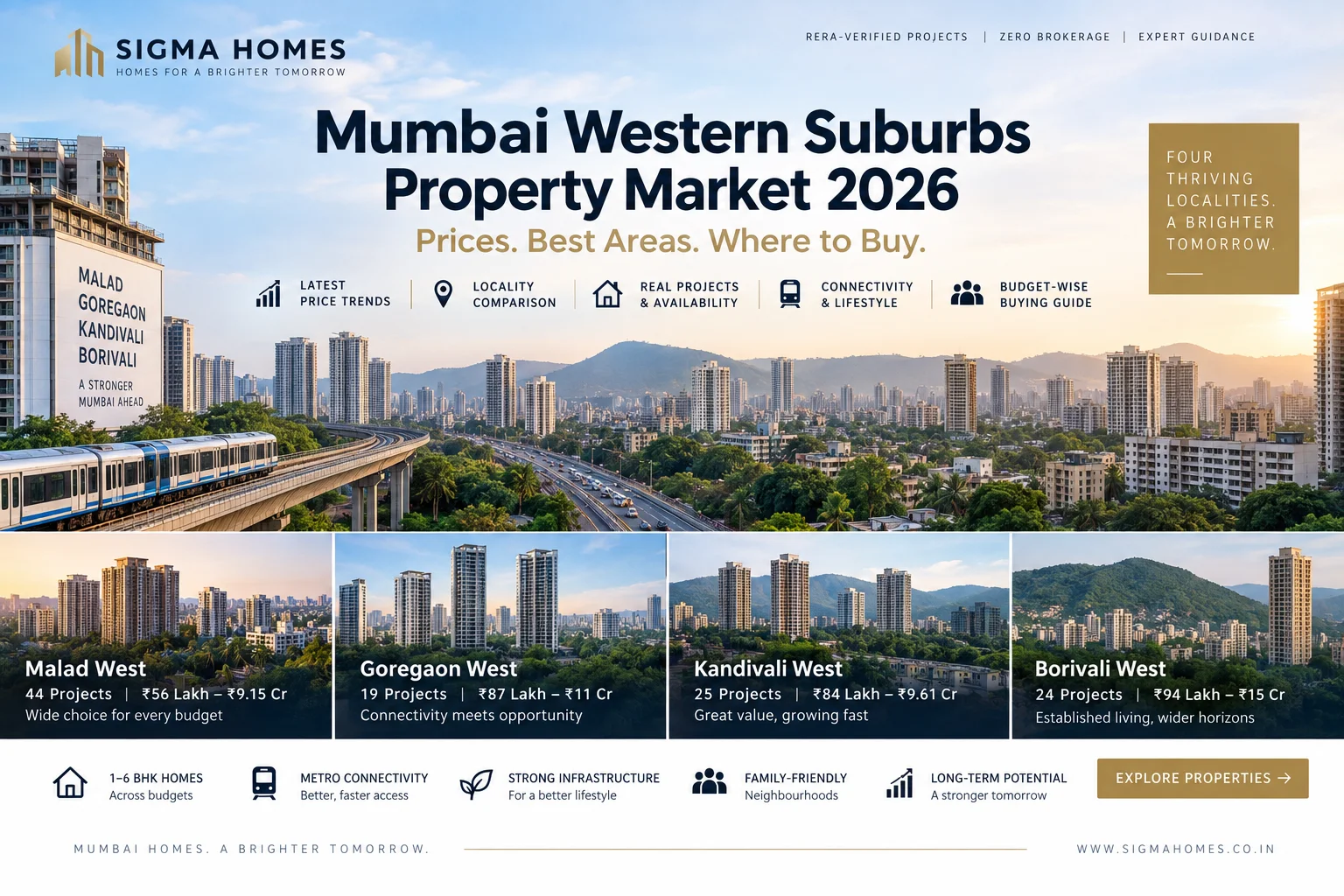
With Zero Brokerage, RERA Registered Projects, Verified Properties and Expert Guidance, our objective is to make the property-buying process more transparent and informed.
Because buying a home is not simply a transaction.
It is a long-term financial and lifestyle decision.