— Buyer's Guide
10 Things to Check Before Buying Property in Mumbai
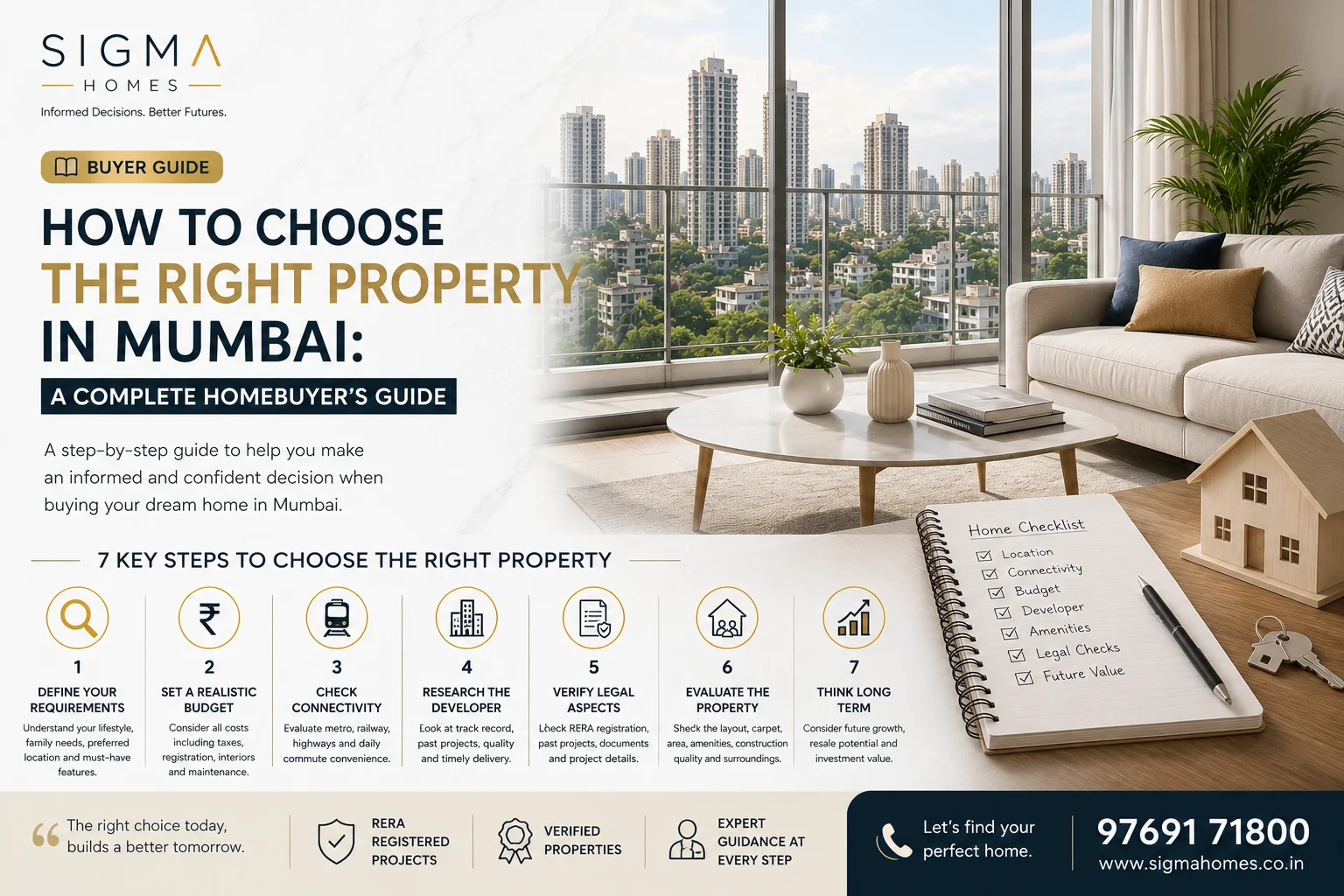
Buying property in Mumbai requires more than comparing prices and visiting sample flats. From location and budget to RERA verification, developer credibility, carpet area, connectivity, amenities and long-term value, this guide covers 10 essential checks every homebuyer should complete before booking a property.
By Admin · Published 15 August 2026 · 5 min read

Buying a property in Mumbai is a major financial commitment. Whether you are purchasing your first home, upgrading to a larger apartment or investing in residential real estate, the right decision requires more than comparing prices and visiting sample flats.
A property may look attractive on paper, but its **location, legal status, developer track record, project documentation, connectivity, construction quality and long-term value** can significantly affect your ownership experience.
Before you pay a booking amount or sign an agreement, here are **10 important things every property buyer in Mumbai should check.**
---
1. Check the Location — Not Just the Address
In Mumbai real estate, location is one of the most important factors influencing both lifestyle and long-term property value.
Don't evaluate a location only by its postal address. Look at the complete neighbourhood ecosystem.
Consider:
- Distance from your workplace
- Metro and railway connectivity
- Major roads and highways
- Schools and colleges
- Hospitals and healthcare facilities
- Shopping and daily conveniences
- Restaurants and entertainment
- Employment hubs
- Traffic conditions
- Future infrastructure development
Also consider how the location is likely to evolve over the next five to ten years.
An upcoming Metro line, road improvement or major infrastructure project can improve accessibility, but buyers should verify the actual status and expected timeline rather than relying solely on promotional claims.
**A good location should work for your lifestyle today while offering credible fundamentals for tomorrow.**
---
2. Set a Realistic Total Budget
One of the most common mistakes buyers make is looking only at the advertised property price.
The actual cost of buying a home can include several additional components, depending on the transaction and applicable rules:
- Stamp duty
- Registration charges
- GST, where applicable
- Parking charges
- Maintenance deposits
- Legal/documentation expenses
- Home-loan-related costs
- Interior and furnishing expenses
- Other applicable project charges
Before shortlisting properties, calculate your **total acquisition cost**, not just the quoted base price.
If you are using a home loan, evaluate the EMI against your regular income and existing financial commitments.
A property should fit comfortably within your financial plan rather than forcing you to stretch your finances simply because the property appears attractive.
---
3. Verify RERA Registration Where Applicable
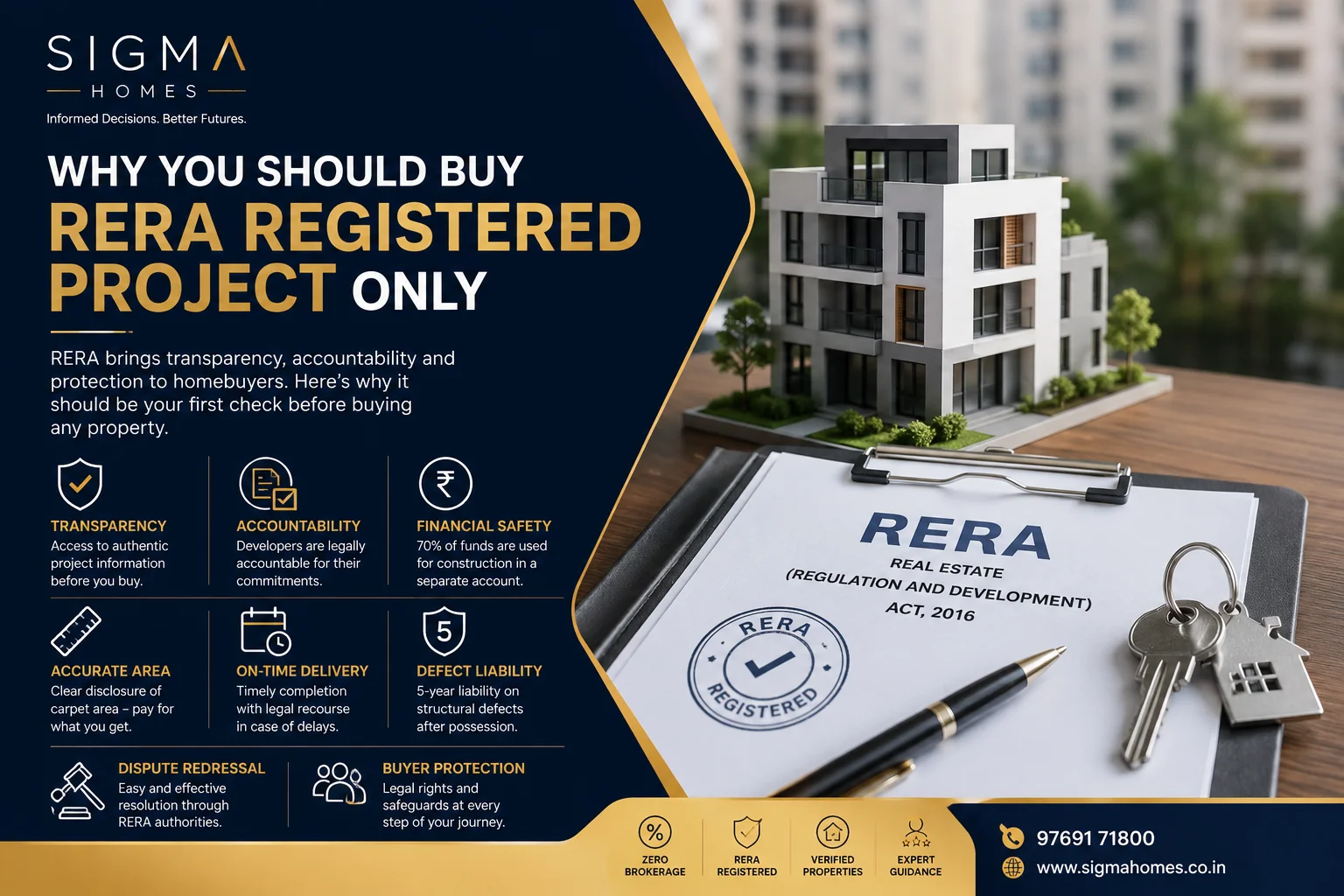
For an eligible project, checking RERA registration should be one of the first steps in your due diligence.
The Real Estate (Regulation and Development) Act, 2016 created a regulatory framework intended to improve transparency, accountability and protection for homebuyers. Covered projects generally need to be registered with the relevant state RERA authority before being marketed or sold, subject to statutory exemptions.
For properties in Maharashtra, buyers can search project information through **MahaRERA**, including registered projects, project status and other available information.
However, **RERA registration alone should not be treated as a complete guarantee of the quality or performance of a project.**
Check:
- Project registration number
- Promoter details
- Registered completion date
- Construction progress
- Uploaded project documents
- Building details
- Available project updates
- Any relevant orders or compliance information
MahaRERA requires promoters to keep certain project information updated, including construction progress, building details, documents and completion information.
Also remember that some projects can be exempt from MahaRERA registration under applicable provisions—for example, certain small projects and projects with specified completion certificates.
**The correct approach is to verify whether RERA registration applies and, where applicable, verify the project's registration directly through the official authority.**
---
4. Research the Developer's Track Record
The developer behind a project can have a significant impact on your buying experience.
Before booking an under-construction property, research the developer's previous projects.
Look at:
- Delivery history
- Construction quality
- Project maintenance
- Customer feedback
- Quality of amenities
- Past project timelines
- Completed developments
- Reputation within the market
A beautiful brochure tells you what a developer promises.
**Completed projects tell you what the developer has actually delivered.**
If possible, visit an older project developed by the same company and speak to existing residents.
---
5. Understand the Carpet Area and Floor Plan
Don't choose an apartment simply because it has a large advertised area.
Understand exactly what you are buying.
Compare properties based on **carpet area, layout efficiency and actual usability**.
Two apartments with the same carpet area can feel completely different depending on the floor plan.
Check:
- Living room size
- Bedroom dimensions
- Kitchen layout
- Balcony
- Storage
- Passage space
- Bathroom locations
- Natural light
- Ventilation
- Privacy between rooms
RERA's framework has also increased transparency around carpet-area disclosures, helping buyers make more meaningful comparisons between properties.
Before booking, ask yourself:
**"How will my family actually use this space every day?"**
That question is often more valuable than simply asking how many square feet the apartment has.
---
6. Evaluate the Project's Construction and Specifications
Don't rely entirely on the sample apartment.
A sample flat is designed to showcase the best possible presentation of the project.
Understand what is actually included in the apartment and project specifications.
Check:
- Construction specifications
- Flooring
- Doors and windows
- Kitchen provisions
- Bathroom fittings
- Electrical points
- Air-conditioning provisions
- Fire-safety provisions
- Lifts
- Power backup
- Water supply
- Security systems
For an under-construction project, compare the sales presentation with the project's registered information and documentation.
---
7. Look at Amenities Through a Lifestyle Lens
Modern residential projects increasingly offer gyms, swimming pools, clubhouses, children's areas, sports facilities, landscaped gardens and other lifestyle amenities.
But don't choose a project simply because it advertises 30, 40 or 50 amenities.
Ask:
**Will my family actually use them?**
For example:
Families with children
Children's play areas, sports facilities and open spaces may be valuable.
Fitness-focused residents
A quality gym, walking track, swimming pool or wellness area may add genuine value.
Senior citizens
Seating areas, gardens and dedicated community spaces can improve everyday comfort.
Working professionals
Co-working or business facilities may be useful.
Amenities can improve quality of life, but they also come with maintenance and operating costs.
**Look for useful amenities, not just a long amenities list.**
---
8. Study Connectivity and Actual Commute Time
A property may be advertised as being "close to the Metro" or "minutes from the highway."
Don't accept such claims at face value.
Check the actual route.
Consider:
- Walking distance
- Road conditions
- Peak-hour traffic
- Public transport availability
- Railway access
- Metro connectivity
- Airport access
- Major employment hubs
If possible, visit the property during **morning and evening peak hours**.
A 3-kilometre journey can sometimes take longer than a 7-kilometre journey in Mumbai depending on the route and traffic.
For end-users, this matters enormously.
**A better commute can directly translate into a better quality of life.**
---
9. Read the Agreement and Understand the Financial Terms
Never make a major property commitment without understanding the documents you are signing.
Pay particular attention to:
- Agreement for Sale
- Payment schedule
- Possession terms
- Cancellation conditions
- Carpet area
- Specifications
- Maintenance obligations
- Parking terms
- Other charges
- Default provisions
- Project-related commitments
RERA's framework includes provisions around the Agreement for Sale and aims to reduce one-sided practices in real estate transactions.
If you are unsure about a legal clause, seek independent professional legal advice before signing.
**A few hours spent understanding the agreement can protect you from years of unnecessary complications.**
---
10. Think About Long-Term Value
The right property should ideally make sense not only on the day you buy it but also several years later.
For an end-user, consider:
- Will the home suit your family as it grows?
- Is the location likely to remain convenient?
- Are schools and healthcare accessible?
- Is the configuration practical?
- Will the neighbourhood continue to develop?
For investors, consider:
- Rental demand
- Potential tenant profile
- Resale demand
- Competing supply
- Infrastructure
- Employment hubs
- Entry price
- Holding period
- Liquidity
Don't buy simply because someone tells you:
> **"Prices will definitely increase."**
No one can guarantee future property appreciation.
Instead, look for **strong fundamentals that can support long-term demand.**
---
Don't Make the Decision After One Site Visit
One of the best ways to improve your property-buying decision is to compare multiple suitable options.
Shortlist at least **three comparable properties** and evaluate them using the same parameters:
| Factor | Property A | Property B | Property C |
|---|---|---|---|
| Location | |||
| Carpet Area | |||
| Total Cost | |||
| Connectivity | |||
| Developer | |||
| RERA Status | |||
| Amenities | |||
| Possession | |||
| Future Potential |
This helps move the decision away from emotion and towards objective comparison.
---
The Sigma Homes Approach
At **Sigma Homes**, we believe that property buying should be an informed process—not a rushed transaction.
Our approach is centred around helping buyers evaluate properties through multiple factors, including:
**Location | Connectivity | Pricing | Developer Credibility | RERA Status | Project Quality | Amenities | Long-Term Suitability**
We help clients explore **verified residential and commercial property opportunities** and provide professional guidance throughout their property journey.
Our philosophy is simple:
**Zero Brokerage | RERA Registered | Verified Properties | Expert Guidance**
Because buying a home isn't just about finding a property.
**It's about making the right decision for your future.**
---
Final Checklist Before You Book
Before paying your booking amount, ask yourself:
**☑ Is the location right for me?**
**☑ Does the total cost fit my budget?**
**☑ Have I verified RERA status where applicable?**
**☑ Have I researched the developer?**
**☑ Do I understand the carpet area and floor plan?**
**☑ Have I checked construction and project specifications?**
**☑ Will my family actually use the amenities?**
**☑ Have I checked the actual commute?**
**☑ Have I understood the Agreement for Sale and payment terms?**
**☑ Have I compared the property with alternatives?**
If the answer to all ten is yes, you are in a much stronger position to make an informed decision.
**SIGMA HOMES**
**Informed Decisions. Better Futures.**
*This article is for general information and buyer education. Property regulations, project information, prices, availability and timelines can change. Buyers should independently verify the latest information and obtain appropriate legal, financial or technical advice before making a property purchase.*