— Buyer's Guide
How to Choose the Right Property in Mumbai: A Complete Homebuyer's Guide
Choosing the right property in Mumbai requires more than comparing prices and brochures. From budget and location to connectivity, developer credibility, RERA verification, carpet area, amenities and future value, this complete homebuyer's guide covers the key factors you should evaluate before making one of your biggest financial decisions.
By Admin · Published 13 August 2026 · 5 min read
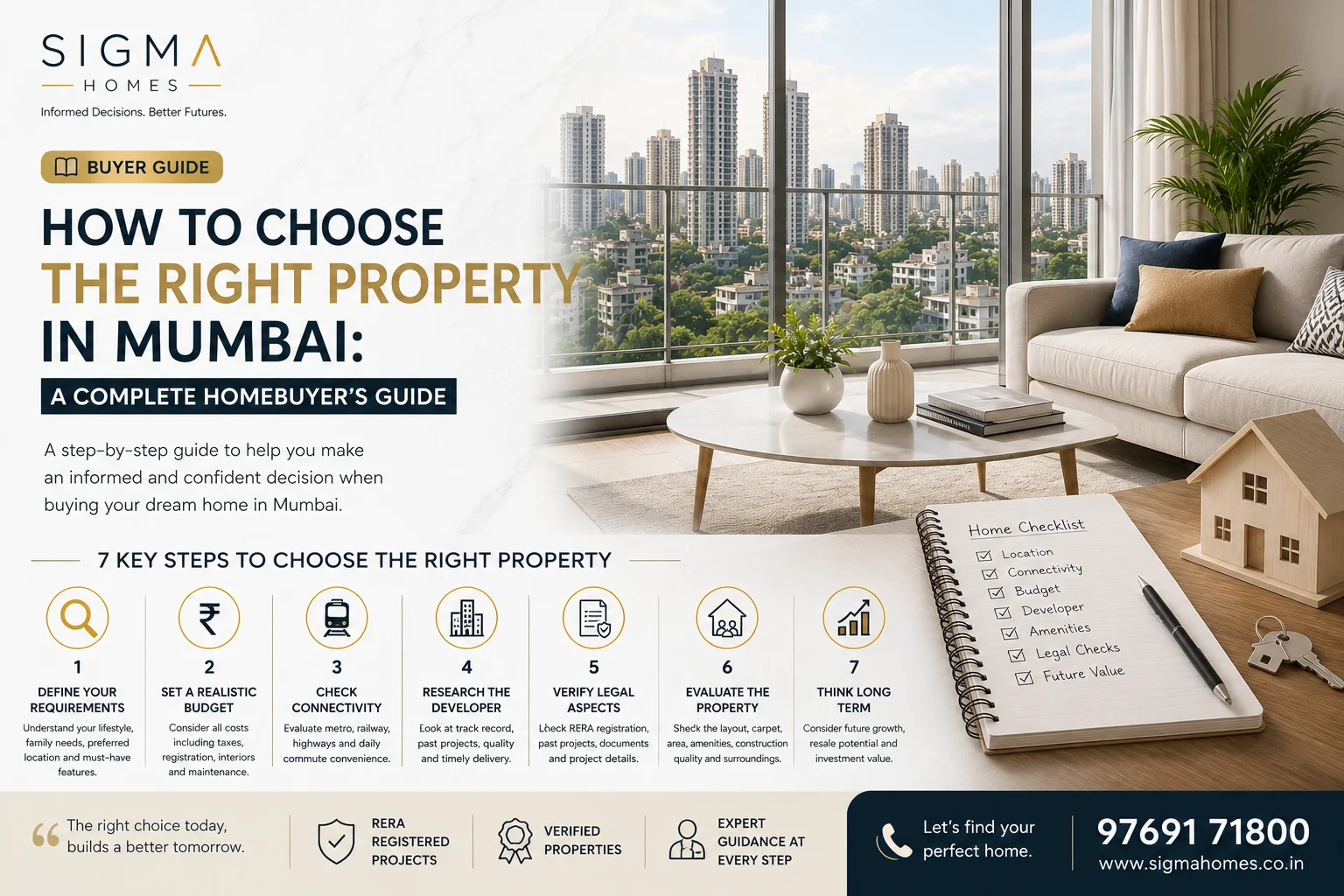
Buying a home in Mumbai is a major financial and lifestyle decision. With hundreds of residential projects, different micro-markets, changing infrastructure and a wide range of budgets, finding the right property can quickly become overwhelming.
The right home is not necessarily the most expensive one, the newest launch or the project with the longest list of amenities. It is the property that offers the right balance of **location, connectivity, quality, price, lifestyle and long-term suitability** for your needs.
At Sigma Homes, we believe that a well-informed buyer makes a better property decision. Here is a practical guide to help you evaluate a home before making a commitment.
1. Start With Your Budget — Not the Property
Before visiting projects, establish a realistic budget.
Your property budget should consider more than the advertised apartment price. Account for registration, taxes, parking, maintenance deposits, interior work, loan-related costs and other applicable charges.
If you are taking a home loan, also consider how the EMI will fit into your monthly financial commitments.
A useful approach is to establish three numbers:
- Your comfortable purchase budget
- Your maximum possible budget
- The amount you want to keep available for emergencies and other financial goals
Having this clarity prevents you from falling in love with a property that is financially uncomfortable.
2. Choose the Right Location and Micro-Market
In Mumbai, **location can be as important as the apartment itself**.
Instead of simply asking, "Which area is best?", ask:
**"Which location is best for my lifestyle and future requirements?"**
Consider your daily commute, workplace, schools, healthcare, family requirements and access to public transportation.
Also evaluate the area's future potential. Upcoming metro routes, road improvements, commercial developments and other infrastructure can influence accessibility and the overall attractiveness of a neighbourhood.
But don't buy a property solely because an infrastructure project has been announced. Check its actual status, expected timelines and practical impact.
A location should work for you **today**, while also having credible fundamentals for tomorrow.
3. Evaluate Connectivity
Mumbai's traffic makes connectivity one of the most important aspects of home selection.
Look at:
- Metro connectivity
- Railway stations
- Major highways
- Main arterial roads
- Bus connectivity
- Airport access
- Access to employment hubs
Also consider the **actual travel time during peak hours**, not just the distance shown on a map.
A property that is technically close to a railway station may still be inconvenient if the access road is congested or difficult to use.
Visit the location at different times of the day before making a decision.
4. Check the Developer's Track Record
The developer is an important part of your property decision, particularly when buying an under-construction project.
Research:
- Previous projects
- Delivery history
- Construction quality
- Customer feedback
- Financial and execution track record
- Quality of amenities after possession
A strong brochure can tell you what a project promises. A developer's completed projects can tell you more about what the developer actually delivers.
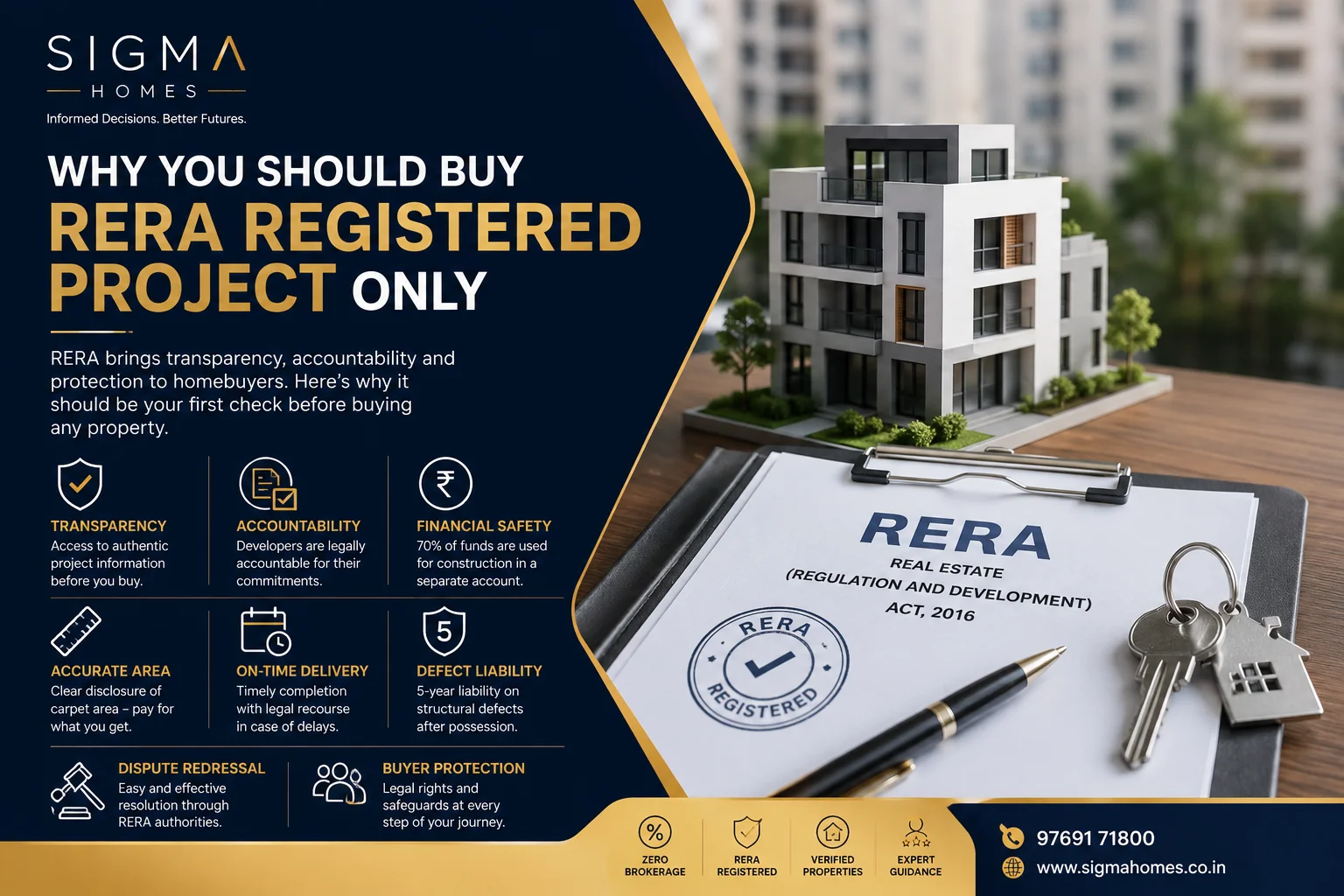
5. Always Verify RERA Registration Where Applicable
For eligible projects, RERA registration should be one of the first checks you make.
RERA was introduced to increase transparency, accountability and financial discipline in India's real estate sector. Registered project information is made available through the relevant regulatory authority, helping buyers make more informed decisions. The framework also includes provisions relating to project disclosures, carpet area, project funds and buyer protections.
For Maharashtra properties, buyers can verify project information through **MahaRERA**.
However, remember that certain projects can fall under statutory exemptions from registration. Therefore, the correct approach is to **verify whether registration is applicable and, where applicable, verify the project's registration and details** rather than simply assuming that every project must have a RERA number.
6. Understand Carpet Area — Not Just the Brochure Size
When comparing apartments, understand exactly how much usable space you are purchasing.
In Maharashtra, project disclosures include apartment information based on **carpet area**, including sold and unsold inventory disclosures.
Don't compare properties only by their advertised "saleable" or "super built-up" area.
Instead, compare:
**Carpet area + layout efficiency + room dimensions + usable spaces.**
A well-designed apartment can sometimes provide a better living experience than a larger apartment with inefficient planning.
7. Look at the Floor Plan Carefully
Two apartments with the same carpet area can feel completely different.
Before booking, consider:
- Living-room proportions
- Bedroom sizes
- Kitchen layout
- Balcony placement
- Natural light
- Ventilation
- Passage area
- Storage
- Privacy between rooms
- Number and position of bathrooms
Think about how your family will actually use the apartment.
A beautiful sample flat can influence emotions, but the **floor plan determines everyday functionality**.
8. Don't Choose a Project Only Because of Amenities
Swimming pools, gyms, clubhouses, sports facilities, lounges and landscaped gardens can improve residential life, but the number of amenities should not be your primary selection criterion.
Ask:
**Will my family actually use these facilities?**
A well-designed amenity package can provide convenience, recreation and community interaction. But amenities also have maintenance costs.
Evaluate the quality, usefulness, maintenance plan and overall contribution to your lifestyle rather than simply counting how many amenities are listed in the brochure.
9. Compare the Total Value, Not Just the Price
A lower price does not automatically mean better value.
Compare properties on:
- Price per sq. ft.
- Carpet area
- Location
- Connectivity
- Developer
- Construction quality
- Amenities
- Possession timeline
- Maintenance
- Future development
- Resale prospects
Two projects priced similarly can have very different long-term value.
The objective should be to identify the **best value for your requirements**, not simply the lowest quotation.
10. Consider Your Future, Not Just Your Present
A property should ideally work for your family for several years.
Ask yourself:
- Will the apartment be large enough if the family grows?
- Is the location suitable for future schooling requirements?
- Will the commute remain practical?
- Does the building offer facilities that match your lifestyle?
- Will the property remain attractive if you need to sell or rent it later?
For investors, the questions are slightly different:
- Is there genuine rental demand?
- Who is the likely tenant?
- What competing supply exists?
- How liquid is the property?
- What is the expected holding period?
11. Visit the Property Before You Decide
Never make a major property decision based entirely on photographs, videos or a presentation.
Visit the actual site.
During your visit, observe:
- Approach roads
- Traffic conditions
- Surrounding buildings
- Noise levels
- Nearby development
- Public transport
- Local amenities
- Construction quality
- Views and natural light
- Overall neighbourhood environment
If possible, visit more than once and at different times.
For a ready property, visit the actual apartment. For an under-construction project, understand the approved plans, specifications, construction status and promised deliverables.
12. Read the Documents Before Paying
Don't rush into a booking because of a limited-period offer or sales pressure.
Before making a significant payment, understand the relevant documents and terms, including:
- RERA/project registration details where applicable
- Allotment letter
- Agreement for Sale
- Approved plans
- Project specifications
- Payment schedule
- Possession terms
- Cancellation provisions
- Maintenance obligations
- Parking terms
- Other applicable charges
For legal or technical matters, professional legal advice can be valuable.
13. Compare at Least Three Suitable Properties
One of the easiest ways to improve your decision is to avoid choosing the first attractive property you see.
Shortlist at least three comparable options and evaluate them using the same criteria:
**Location | Price | Carpet Area | Connectivity | Developer | Amenities | Possession | Future Potential**
This makes the decision more objective.
The purpose of comparison is not necessarily to find a "winner." It is to understand what you are getting for your money.
14. Think Like an End-User Even If You Are an Investor
An investment property ultimately needs demand.
A property that people genuinely want to live in can often have a broader potential tenant or buyer base.
Therefore, investors should also examine:
- Employment hubs
- Transport connectivity
- Schools and healthcare
- Retail and entertainment
- Neighbourhood quality
- Rental demand
- Competing properties
Strong fundamentals matter more than a short-term marketing narrative.
The Sigma Homes Approach
At **Sigma Homes**, we believe choosing a property should be an informed process rather than a rushed transaction.
Our approach focuses on helping buyers evaluate properties through multiple factors, including **location, connectivity, pricing, developer credibility, RERA status where applicable, project quality, amenities and long-term suitability**.
We help clients explore **verified properties and suitable residential and commercial opportunities**, with professional guidance throughout the property journey.
Our philosophy is simple:
**Zero Brokerage | RERA Registered | Verified Properties | Expert Guidance**
Final Thoughts
There is no single "best property in Mumbai."
There is only the **right property for a particular buyer, budget, lifestyle and objective**.
A successful home purchase begins with asking the right questions and taking the time to verify the answers.
Before you book, remember:
**Check the location.
Compare the value.
Verify the project.
Understand the documents.
Visit the property.
Think about the future.**
A home is more than a financial transaction. It is where your family may spend years of its life.
Choose accordingly.
**SIGMA HOMES — Informed Decisions. Better Futures.**
*Property regulations, project information, availability, pricing and timelines can change. Buyers should independently verify the latest information and obtain appropriate professional advice before making a purchase decision.*