— Buyer's Guide
Why You Should Buy a RERA-Registered Project: A Homebuyer's Guide
RERA has brought greater transparency and accountability to India's real estate sector. But what does RERA registration actually mean for a homebuyer? From project disclosures and financial discipline to carpet-area clarity, possession timelines and buyer protections, this guide explains the key benefits of choosing a RERA-registered project and the important checks you should complete before booking.
By Admin · Published 12 August 2026 · 5 min read
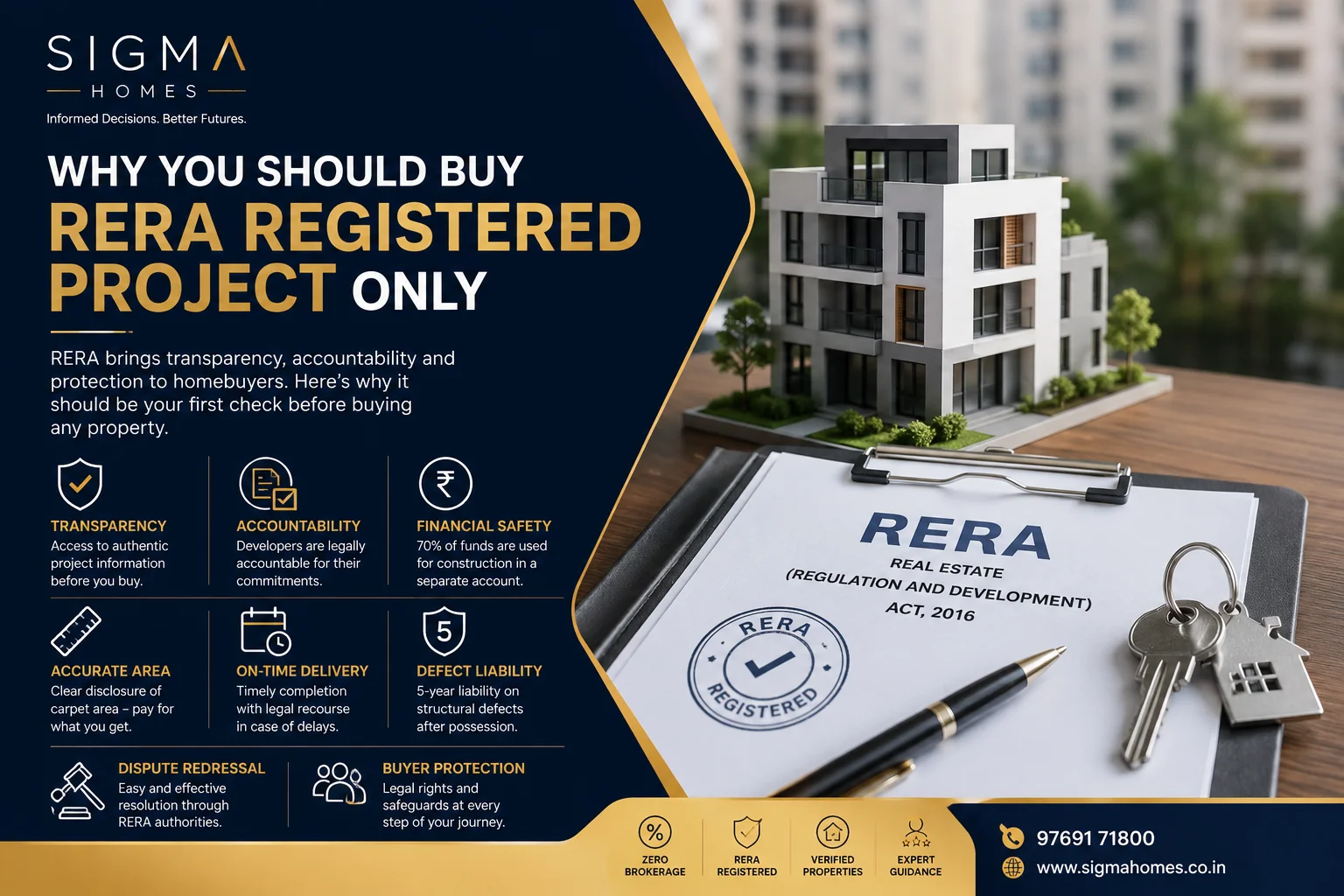
Buying a home is one of the biggest financial decisions most people make. Whether you are purchasing your first home, upgrading to a larger apartment or investing in residential property, choosing the right project is just as important as choosing the right location.
One of the most important checks a homebuyer should make before booking an eligible real estate project is its **RERA registration**.
The Real Estate (Regulation and Development) Act, 2016 was introduced to bring greater transparency, accountability and financial discipline to the real estate sector while protecting the interests of homebuyers. The law requires covered real estate projects to be registered with the relevant state Real Estate Regulatory Authority before they can be advertised, marketed, booked or offered for sale.
For buyers in Maharashtra, this means checking the project's registration and available disclosures on **MahaRERA** before making a purchase decision.
What Is RERA?
RERA stands for the **Real Estate (Regulation and Development) Act, 2016**.
Under the framework, eligible real estate projects are required to be registered with the respective state RERA authority. Developers are required to provide important project information and comply with the applicable provisions of the Act.
The objective is simple: **make real estate transactions more transparent and give homebuyers better information before they commit their money.**
However, not every project necessarily requires registration. The Act provides certain exemptions, including specified small projects and other situations covered under the law. Therefore, buyers should verify whether a project is required to be registered rather than assuming that the absence of a RERA number automatically means a project is illegal.
Why Should Homebuyers Prefer RERA-Registered Projects?
1. Greater Transparency
One of the biggest advantages of RERA is improved access to project information.
For a registered project, buyers can access important information relating to the project through the relevant regulatory authority. This can help a buyer understand the development before making a financial commitment.
Instead of relying entirely on a sales presentation or brochure, buyers can carry out additional verification using regulatory information.
**For a homebuyer, better information means better decision-making.**
2. Better Accountability
RERA has introduced greater accountability into the relationship between developers and homebuyers.
Promoters of registered projects are required to comply with various regulatory obligations relating to project information, disclosures and development.
This creates a more structured framework for the transaction and gives buyers a regulatory mechanism through which their rights can be addressed.
3. Greater Financial Discipline
One of the important provisions under RERA relates to the use of funds collected from homebuyers.
The central government's explanation of RERA states that **70% of the amount collected from buyers must be deposited into a separate bank account for the construction of that project**, with withdrawals subject to prescribed certification requirements.
This provision is intended to improve financial discipline and reduce the risk of funds being diverted away from the project for unrelated purposes.
4. Greater Clarity About Carpet Area
RERA places importance on transparent disclosure of the **carpet area** of a property.
For homebuyers, this is particularly useful because the carpet area provides a more meaningful basis for comparing homes than simply comparing an advertised "saleable" or "super built-up" figure.
When comparing two apartments, buyers should always understand exactly what area they are paying for.
5. Protection Against Unapproved Changes
RERA provides safeguards regarding changes to sanctioned plans and project specifications.
Certain changes require the consent of the required proportion of allottees, providing buyers with greater protection against significant unilateral alterations to the project.
This is particularly important when purchasing in a large residential development where the final project can have a major impact on the value and usability of the property.
6. Greater Focus on Timely Completion
Project delays have historically been one of the biggest concerns for Indian homebuyers.
RERA establishes obligations around project completion and provides remedies in cases covered by the Act when a promoter fails to meet applicable obligations.
Depending on the circumstances and applicable provisions, buyers may have rights relating to delay, including interest or refund-related remedies.
This does not mean that every RERA-registered project will automatically be delivered exactly on the original date. Buyers should still examine the project's registered completion timeline, extensions and current status.
**RERA registration is protection through regulation—not a guarantee that delays can never happen.**
7. Structural Defect Protection
The RERA framework provides a **five-year liability for structural defects** from the date of possession, subject to the conditions and provisions of the law.
For a homebuyer, this provides an important layer of statutory protection after possession.
8. A Regulatory Dispute-Resolution Mechanism
One of the significant benefits of RERA is the availability of a dedicated regulatory framework for addressing eligible disputes.
The system includes the Real Estate Regulatory Authority, an adjudicating mechanism and an appellate tribunal.
This gives homebuyers a formal regulatory route when disputes arise within the scope of the Act.
RERA Registered Does Not Mean "Buy Without Checking Anything"
This is one of the most important points for every homebuyer to understand.
**RERA registration is an important safety check, but it should not be the only safety check.**
A registered project can still differ from another registered project in terms of location, developer track record, pricing, construction quality, connectivity, amenities and investment potential.
Before booking a property, buyers should also evaluate:
- Developer's track record
- Project location and connectivity
- RERA registration details
- Registered completion date
- Approved plans and project specifications
- Carpet area
- Pricing compared with similar projects
- Construction progress
- Project amenities
- Title and legal documentation
- Home-loan eligibility
- Maintenance and other associated costs
- Future infrastructure and surrounding development
- Resale and rental potential
A good property decision comes from **combining regulatory verification with commercial and practical due diligence.**
How to Check a RERA Project Before Booking
Before paying a booking amount, buyers should verify the project's registration on the relevant state RERA portal.
For a property in Maharashtra, buyers can use the **MahaRERA** platform to check the project and review available information.
Look for details such as:
**Project Registration Number**
Confirm that the project has a valid registration where registration is applicable.
**Promoter Details**
Verify the developer/promoter information.
**Project Status**
Check the project's current status and registered completion information.
**Building and Unit Details**
Compare the property being offered with the information available for the registered project.
**Approvals and Disclosures**
Review the documents and disclosures available through the regulatory portal.
**Project Updates**
Where available, examine updates regarding construction progress and project status.
Do not rely solely on screenshots or documents provided by a salesperson. Whenever possible, verify the information directly through the official regulatory portal.
The Sigma Homes Approach
At **Sigma Homes**, we believe that buying property should begin with verification—not simply a sales pitch.
Our approach focuses on helping buyers evaluate properties through multiple factors, including **RERA registration, location, pricing, developer credibility, project quality, connectivity and long-term suitability**.
We focus on **verified properties and RERA-registered projects where applicable**, while helping clients understand the information available before they make an important property decision.
Our philosophy is simple:
**Zero Brokerage | RERA Registered | Verified Properties | Expert Guidance**
Because a property purchase is not just about finding a beautiful home.
It is about making a decision that is financially sound, legally informed and suitable for your future.
Final Thoughts
RERA has significantly changed the way buyers can evaluate real estate projects in India by introducing greater transparency, accountability and regulatory oversight.
For homebuyers, checking RERA registration should be considered an essential part of the property-buying process whenever the project falls within the registration requirements.
But don't stop at the RERA number.
**Verify. Compare. Understand. Then decide.**
The right property is not simply the one with the best brochure or the most attractive offer. It is the property that combines **regulatory compliance, location, quality, value and long-term suitability**.
At Sigma Homes, our objective is to help you make that decision with greater clarity and confidence.
**SIGMA HOMES — Informed Decisions. Better Futures.**