— Buyer's Guide
Home Loan for a Mumbai Flat: Eligibility, Documents and Pre-EMI vs Full EMI Explained
How a home loan works for a Mumbai flat: eligibility, documents, down payment, and how pre-EMI differs from full EMI on under-construction homes.
By Sigma Homes · Published 26 October 2026 · Updated 26 October 2026 · 7 min read
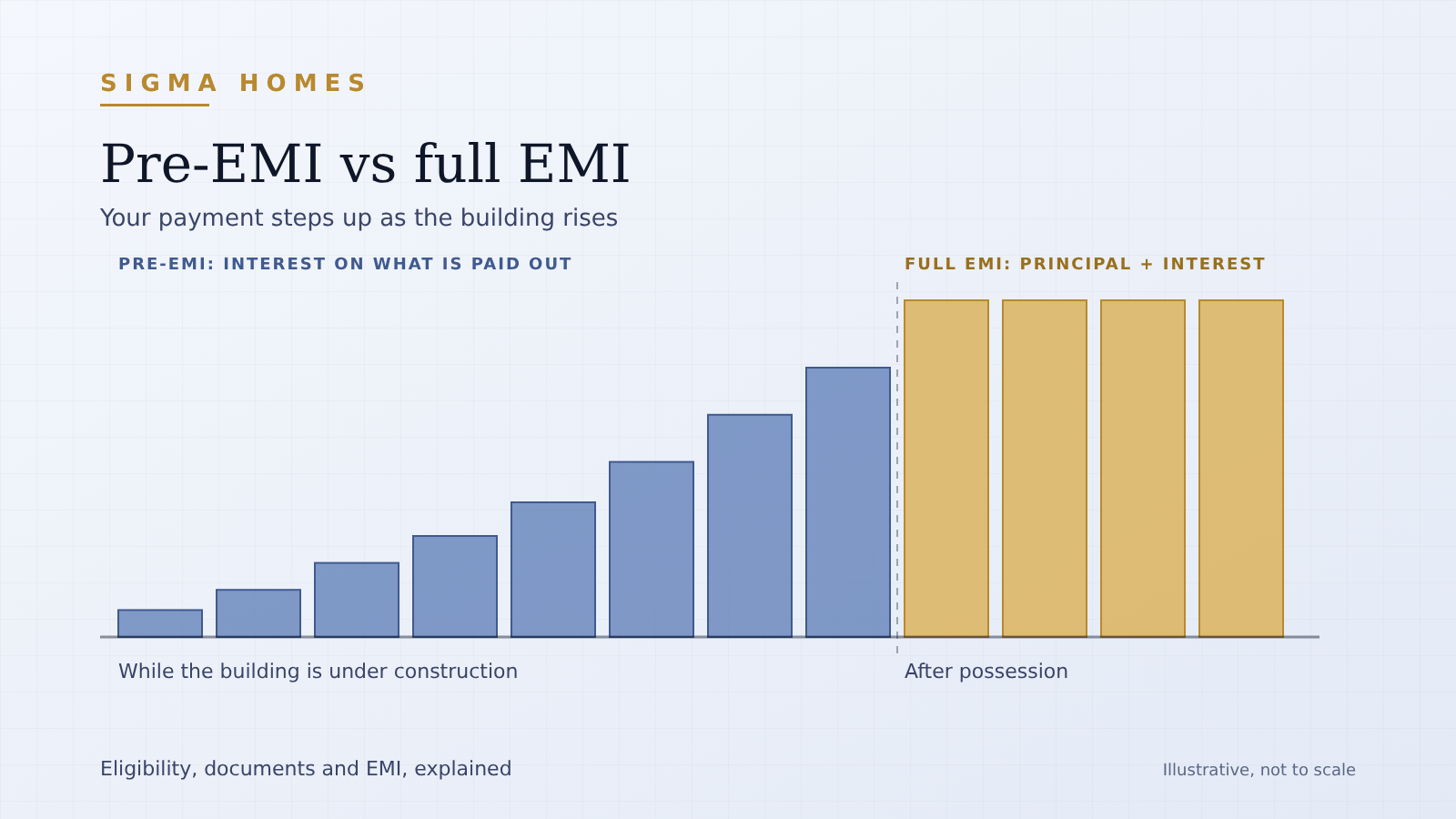
To get a home loan for a Mumbai flat, a lender checks your income, credit score, existing EMIs, age and the property itself. The loan covers only part of the price, so you pay the rest as a down payment, along with stamp duty, registration and GST. On an under-construction flat, the lender releases the loan in stages as the building progresses, and you pay only interest on the amount released (pre-EMI) until the full loan is disbursed. Full EMIs begin after that.
This guide explains each step in plain terms, with worked numbers, so you can plan before you book.
How a home loan works in four steps
- Check your eligibility. The lender looks at your income, credit history and obligations.
- Get a sanction. The lender approves a loan amount, tenure and rate, subject to the property's papers.
- Book the flat and pay your share. You pay the down payment to the developer. The lender pays the loan portion directly to the developer.
- Repay. You pay pre-EMI during construction, then full EMI.
What lenders check for eligibility
| Factor | What the lender looks at |
|---|---|
| Income and stability | Salary or business income, and how steady it is |
| Credit score | A score of 750 or above is commonly preferred; a lower score can mean a higher rate or a smaller loan |
| Existing EMIs | Many lenders prefer total EMIs, including the new one, to stay within roughly 40 to 50 percent of monthly take-home income |
| Age and tenure | Younger applicants can usually take longer tenures, up to the lender's limit |
| Co-applicant | A spouse or family member with income can raise the amount you qualify for |
| The property | Legal title, approvals and, for new projects, RERA registration |
Lenders set their own limits, so two lenders can give you different offers for the same profile.
Documents you will usually need
For every applicant
- Identity and address proof (PAN and Aadhaar are commonly asked for)
- Recent passport-size photographs
If you are salaried
- Latest salary slips
- Form 16 or income tax returns
- Bank statements for the past six months
If you are self-employed
- Income tax returns with computation of income for the past two to three years
- Profit and loss account and balance sheet
- Business proof and bank statements
For the property
- Allotment letter or Agreement for Sale
- Developer's RERA registration number and approvals
- Payment receipts and demand letters
The exact list varies by lender and profile, so ask for the checklist when you apply.
The down payment and other costs
A lender finances only a percentage of the property value. The rest, your down payment, comes from your own funds. Stamp duty, registration charges and GST are separate costs and are usually not part of the loan. Add them up before you decide your budget with our total cost guide. The share a lender will finance depends on the loan size and the lender's policy, so ask for it in writing.
What your EMI could look like
The table shows the monthly EMI for a ₹1 crore and a ₹2 crore loan at three illustrative interest rates. These rates are examples for comparison, not current offers. Your actual rate depends on the lender and your profile.
| Loan | Tenure | EMI at 8% | EMI at 9% | EMI at 10% |
|---|---|---|---|---|
| ₹1 crore | 20 years | ₹83,644 | ₹89,973 | ₹96,502 |
| ₹1 crore | 25 years | ₹77,182 | ₹83,920 | ₹90,870 |
| ₹2 crore | 20 years | ₹1,67,288 | ₹1,79,945 | ₹1,93,004 |
| ₹2 crore | 25 years | ₹1,54,363 | ₹1,67,839 | ₹1,81,740 |
A longer tenure lowers the EMI but increases the total interest you pay. Try your own numbers on the Sigma Homes calculator.
Pre-EMI vs full EMI on an under-construction flat
This is the part most first-time buyers miss.
- Pre-EMI: On an under-construction flat the lender does not release the whole loan on day one. It releases money in stages, as the developer completes construction milestones. Until the loan is fully released, you pay interest only on the amount released so far.
- Full EMI: Once the whole loan is released, you pay the regular EMI, which includes principal and interest.
An illustration on a ₹1 crore loan at 9 percent, which is approximate:
| Stage | Amount released | Monthly pre-EMI (interest only) |
|---|---|---|
| Early stage | ₹30 lakh | about ₹22,500 |
| Mid stage | ₹50 lakh | about ₹37,500 |
| Fully released | ₹1 crore | about ₹75,000 |
Once fully released, the full 20-year EMI at 9 percent would be about ₹89,973. For a flat with possession several years away, you may pay rent elsewhere while also paying pre-EMI, so plan for both. The trade-off is covered in our guide to under-construction vs ready-to-move flats.
Interest-subsidy and "no EMI till possession" offers
Some developers offer payment plans where the developer bears part of the interest for a period. Before you accept one, ask:
- Who pays the interest after the scheme period ends?
- Is the price different from the standard plan?
- What happens if possession is delayed?
- Is everything written into the agreement?
A scheme can lower your outgo in the early years, but it does not remove the loan.
Floating vs fixed rate
Most home loans are on a floating rate, which means the rate can change over the tenure, and so can your EMI or your tenure. Ask the lender how rate changes will be passed on and what the process is to switch. Check the sanction letter for processing fees and any prepayment or foreclosure charges before you sign.
Before you book: a short checklist
- Get an in-principle approval so you know your budget.
- Confirm the project is approved by your lender, and check its approvals and occupation certificate with our OC and CC guide.
- Compare total cost of the loan, not only the rate: fees, insurance and charges.
- Keep a buffer for rate changes and for the gap between booking and possession.
- Ask a chartered accountant about tax benefits that may apply to you.
Browsing by budget? See flats in Mumbai under ₹50 lakh, ₹75 lakh and ₹1 crore, and our guide to buying without brokerage.
This guide is for general information and is not financial advice. Rates, rules and eligibility change, and each lender sets its own terms. Confirm the details with your lender before you decide.
SIGMA HOMES · Zero Brokerage · RERA Registered · Verified Properties